Bulgaria

MONUMENT OF GRATITUDE, PLOVDIV

The white Monument of Gratitude on Tsar Kaloyan Square was erected in 1998 by local Jews. Its inscription reads in Bulgarian, Hebrew and English: "To all who helped to rescue us on 10 March 1943. From the grateful Jewish community of Plovdiv." Every year the citizens of Plovdiv gather at the monument to mark the date on which their fellow Jewish citizens were not deported. 

JEWISH CEMETERY, PLOVDIV

The old Jewish cemetery, like the cemeteries of all other minority groups in Plovdiv, was destroyed in the first years after 1878 when a new urban plan for Plovdiv was adopted. Since then Jews have used a section of the municipal cemetery. It is next to the walled-off and largely abandoned Turkish cemetery. It is unfenced and unguarded, but its north side has been protected by a brick wall, erected by Shalom, to separate it from a local Gypsy settlement. Most of the marble and granite tombstones are still standing but some have been vandalised.

ORTA MEZAR BATH HOUSE

The old Jewish Bath House is across Sixth September Boulevard, on Tsar Kaloyan Square. Erected in the 15th-16th centuries, the Orta Mezar bath house was initially used by Turks. Jews started attending it as they settled in that area of town. The building was slated for demolition as early as the 1920s but that never came to be. Elderly Jews in Plovdiv can still remember going there with their families to take a bath. The Orta Mezar bath house survived even the massive construction effort of the 1980s. Following the collapse of Communism in 1989, the local city council, whose property the building was, started renting it out to shops and businesses. Lastly, the former bath house was a furniture shop – until a fire gutted it, in 2016. Since then the charming Ottoman building has laid in ruins.

PLEVEN JEWISH CEMETERY

Pleven, in northern Bulgaria, had a Jewish community since at least the Middle Ages. When the Hungarians overtook Vidin in 1376 many Vidin Jews departed and settled in Pleven to join the well-established local community consisting of both Sephardis and Romaniotes. In 1470 they were joined by a number of Ashkenazis fleeing persecution in Bavaria. The mixed community quarrelled about their rites and customs. The conflict was put down by Yosef Karo who persuaded the Pleven Jews to adopt the traditions of the Sephardis, who were the majority. A century later the Jews emerged as the second largest minority in Pleven. They are said to have had four synagogues at the end of the 17th century. Now all that remains of Pleven's Jewish heritage is a cemetery located off the road to Radishevo. This is where Chelibon Grasiani, one of the Jews who fought on the Russian side in the 1877-1878 Russo-Turkish War, was buried. The site has been encroached upon by developments. 

PAZARDZHIK OLD SYNAGOGUES

Right in the centre of Pazardzhik, in an easy-to-find passage off a main street, there are two surprisingly well-preserved synagogues dating back to the Bulgarian Revival Period. 

The older of the two, known as the Great Synagogue, was erected in 1850 by a Bulgarian master builder. The synagogue contains some fine examples of the ornaments in vogue at the time, including a marvellous wood-carved ceiling and fine frescos. It is five metres tall and it has as many as 30 windows. Characteristic of many 19th-century Balkan synagogues of the Ottoman era, there are four wooden pillars in the centre of the building, probably once used to support a canopy over the bimah. 

The Small Synagogue was built in 1872 on the spot of a former synagogue that had burnt down. 

During the Communist years the Great Synagogue was used by the local History Museum. The two Pazardzhik synagogues are in good shape structurally, but have not been used for worship for many years. They are kept locked, and one is rented out to a local restaurant. 

PAZARDZHIK JEWISH CEMETERY

Pazardzhik has a large Jewish cemetery, situated at the northeastern entrance of the town. It has two sections, separated from the rest of the Pazardzhik Central Cemetery by a fence. The old section contains over 700 mainly 19th century tombstones with inscriptions in Hebrew and Bulgarian. The new section was opened in 1991 and is still in use. 

BEIT YOSEF PARK IN NIKOPOL

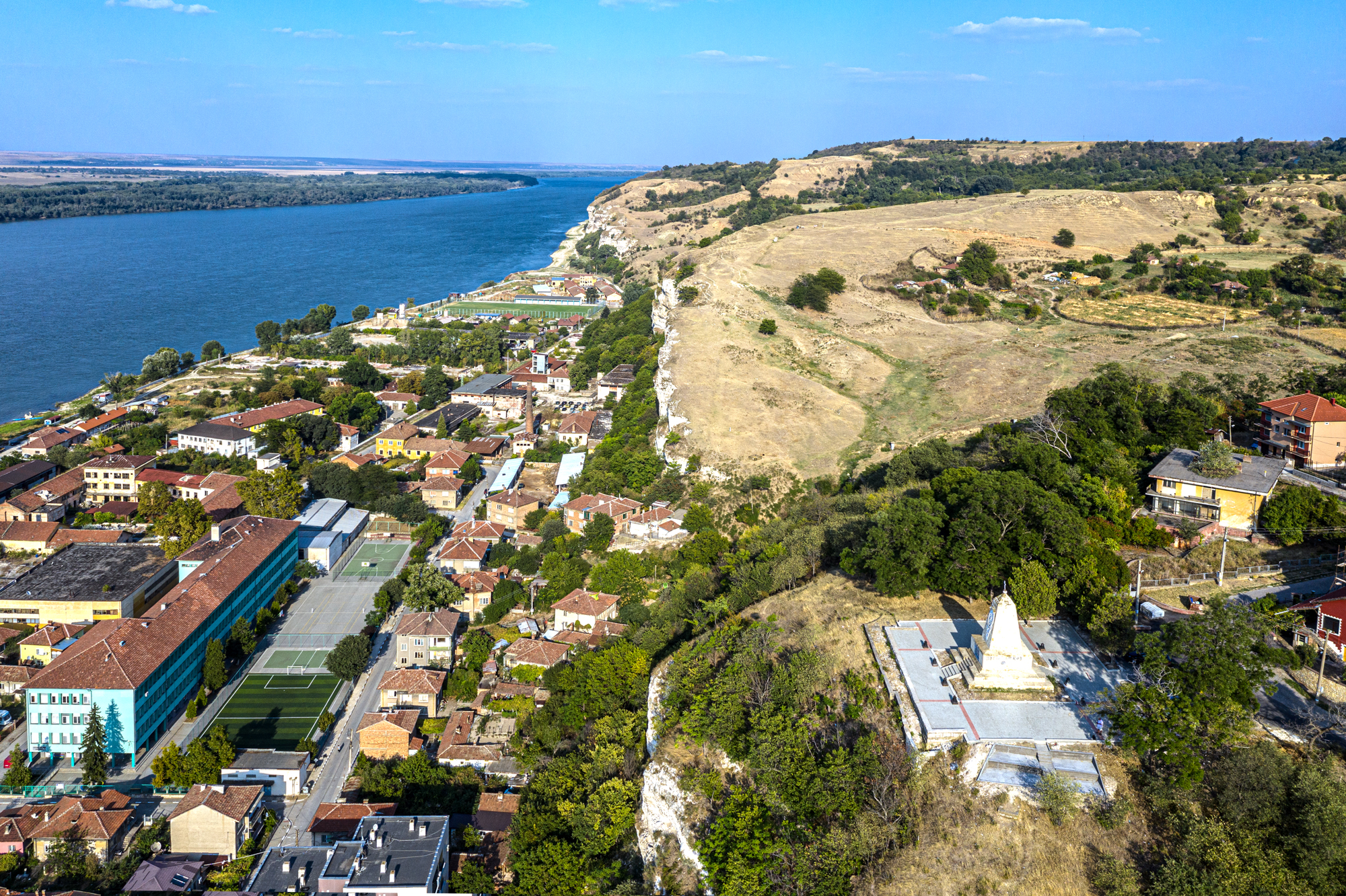
In modern Nikopol there is a plaque dedicated to famed Jewish schollar Joseph Karo and a small park called Beit Yosef, another name for his seminal work Shulchan Aruch. 

Codifying the various Jewish legal traditions, prayers, holidays, eating precepts, marriages, divorces and civil law is a huge task. The man who did it was Rabbi Joseph Karo (1488-1575). His monumental Shulchan Aruch is now known to every Jew and his abode in Safed has become a pilgrimage site. What is less known about the 16th century Jewish scholar and mystic is that he actually spent some of his life in the Bulgarian lands. 

Jospeh Karo was born in a Sephardi family in Toledo, Spain. He was expelled from his home at the age of four, in 1492. During the next several decades his family migrated through various parts of the Ottoman Empire: Adrianople, Salonica and what is now a nondescript little town at the Bulgarian shore of the River Danube, Nikopol. It was in Nikopol that Karo started work on his Kessef Mishneh, a book of commentary on Maimonides, the medieval Jewish philosopher. 

One anecdote attributed to Karo is his encounter with a zealous student. "Name the five volumes of the Shulchan Aruh," the rabbi said. The student, thinking that the rabbi had made a slip of the tongue, named the four volumes, but the rabbi asked him to name the fifth. 

"There is no fifth volume," the student said. 

"There is indeed," the rabbi said. "Common sense is the fifth volume, and if you don't have it, all your rulings will be of no use, even if you know the other four volumes by heart."